
Fed Governor Waller Sees Signs of Easing Inflation, Contrasting Fed Chair Kevin Warsh
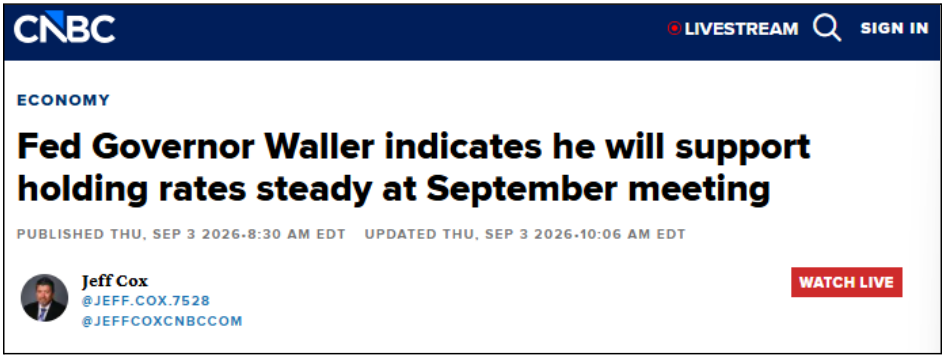
Federal Reserve Governor Christopher Waller said on Thursday that he is leaning towards holding interest rates at the September FOMC meeting, provided there is no significant upside surprise in the upcoming CPI report.
While Waller acknowledged that inflation remains “meaningfully above” the Fed’s 2% target, he pointed to recent trends as evidence that inflationary pressures may be easing. Although annual PCE and core PCE inflation stood at 3.7% and 3.3% respectively in July, Waller argued that annual figures may not provide the clearest picture of current inflation trends. He highlighted that the three-month PCE inflation rate has fallen from 4.76% in February to 3.05% currently, suggesting that underlying price pressures have been moderating.
Waller’s assessment contrasts with Fed Chair Kevin Warsh’s remarks at the Jackson Hole Symposium last week, where he emphasized that inflation remains above the Fed’s 2% target. The differing views from Fed officials have added uncertainty to the outlook for monetary policy ahead of the September FOMC meeting.
Following Waller’s comments, the probability of a September rate hike fell from around 60% to 50.2% according to the CME FedWatch Tool.
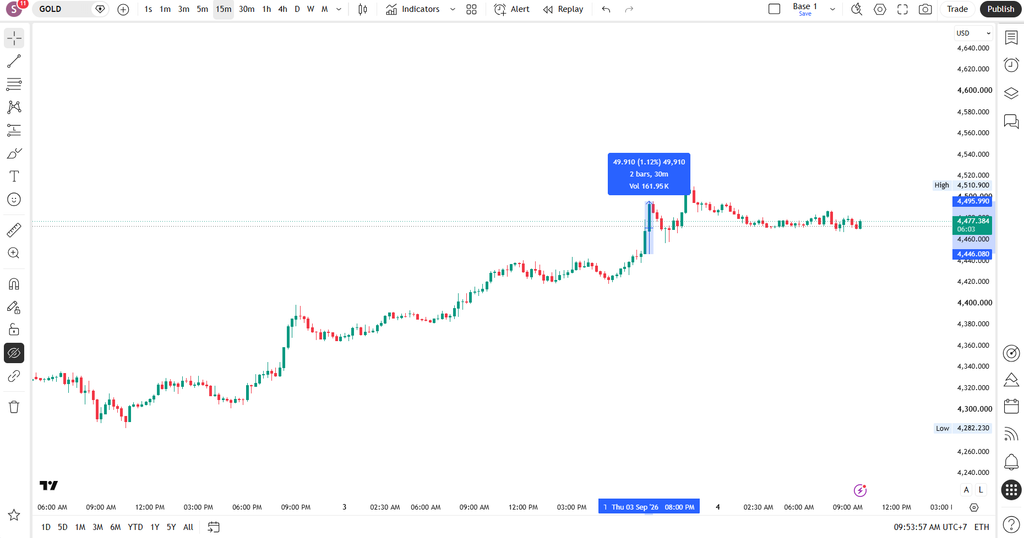
The shift in rate expectations supported gold, with the precious metal rising 1.12% following his remarks, as lower interest-rate expectations generally benefit gold due to its lack of yield compared with interest-bearing assets.
Suspected Japanese Yen Intervention Pressures the US Dollar
The Japanese Yen strengthened sharply against the US Dollar over the past two days, fueling speculation that Japanese authorities may have intervened in the currency market. On Wednesday, the Yen jumped 1.23% against the US Dollar, followed by another 2.14% gain yesterday. The moves came after USD/JPY crossed the 160 level, which has previously been viewed as a key threshold for potential Japanese intervention.
The sharp appreciation has raised comparisons with the last reported joint intervention by Japan and the US on July 31. However, there has been no official confirmation from Japanese authorities that intervention has taken place this time. Instead, some market participants believe the Yen’s recent strength may have been driven by Bank of Japan Governor Kazuo Ueda’s comments regarding the possibility of a rate hike in September.
Regardless of the cause, the Yen’s rapid appreciation has placed pressure on the US Dollar, which can be supportive for gold as the precious metal is typically inversely correlated with the Dollar. The weaker US Dollar may therefore have been another contributing factor behind gold’s rally over the past two days, alongside shifting expectations for US monetary policy.