
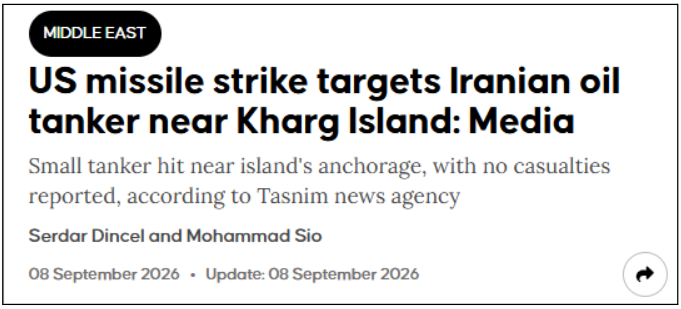
Reports of explosions being heard near Kharg Island, one of Iran’s key oil export hubs, emerged at around 1:55 AM (GMT+7), raising concerns over potential disruptions to oil supply in the region. The reports came as tensions surrounding the war have continued to escalate over the past several days, adding further uncertainty to the outlook for energy markets.
Following the news, oil prices briefly jumped 0.88%, while gold prices briefly slipped 0.22%. The contrasting reaction highlights the market’s focus on the potential inflationary impact of higher oil prices. Higher oil prices can increase transportation and production costs, potentially keeping inflation elevated. This could reinforce expectations for tighter monetary policy from the Federal Reserve (Fed), creating downward pressure on gold.
Middle East Tensions Continue to Escalate
The reports near Kharg Island came amid a broader escalation in tensions across the region. On September 8, reports emerged that Iranian-backed Houthis in Yemen launched strikes on four cities in Saudi Arabia, including Abha, Khamis Mushait, Jizan, and Najran.
The developments have raised concerns that the conflict could increasingly threaten key energy infrastructure and transportation routes across the Middle East. With risks surrounding major oil-producing regions and critical shipping routes such as the Strait of Hormuz and Red Sea, markets are closely watching for signs of further disruptions to global oil supplies.
Oil Approaches the $100 Mark
Despite the escalation in tensions, oil has yet to break above the psychologically important $100 per barrel level. Brent crude is now trading around $99 per barrel, putting the benchmark within striking distance of the key level.
If tensions escalate further and begin to cause more significant disruptions to oil production or transportation, oil could potentially break above $100 per barrel. Such a move could have broader implications for financial markets, particularly if higher energy prices translate into stronger inflation expectations.
For gold, the potential impact could occur through a chain reaction:
Escalating tensions → Higher oil supply risks → Higher oil prices → Stronger inflation expectations → Greater expectations for tighter Fed policy → Pressure on gold
While geopolitical tensions can traditionally support gold through safe-haven demand, a sharp increase in oil prices could create a counteracting force by raising inflation concerns and reducing expectations for monetary policy easing.
This dynamic could become particularly important as markets remain focused on US CPI, the last major inflation data release ahead of the upcoming FOMC meeting. If oil prices continue to rise and reinforce concerns over persistent inflation, markets could become more cautious about expectations for Fed rate cuts—or even begin pricing in a greater possibility of tighter policy.