
Japanese Yen Strengthens as BoJ Rate Hike Bets Grow
The Japanese Yen continued to strengthen against the US Dollar, with the USD/JPY pair closing Monday down 0.67% and falling to its lowest level since February. The Yen’s recent strength has been supported by several factors, with Japan’s latest economic data adding further momentum to expectations of tighter monetary policy.

Japan’s Q2 GDP growth came in at 0.4%, above the 0.3% forecast, strengthening the case for the Bank of Japan (BoJ) to raise interest rates at its meeting next week. This comes after several BoJ officials, including Governor Ueda and board member Takata, made hawkish remarks over the past week regarding the possibility of further rate hikes.
Meanwhile, suspected intervention by Japanese authorities, which reportedly began last week, may have also contributed to the Yen’s recent rally. The combination of stronger-than-expected economic data, hawkish BoJ expectations, and potential intervention has therefore placed further upward pressure on the Japanese Yen.
The Yen’s strength has also spilled over into broader US Dollar weakness, which could provide additional support for gold prices. Traders should therefore keep a close eye on the USD/JPY pair, particularly for any impulsive moves, as significant movements in the pair could potentially spill over into the gold market.
US-Iran Tensions Push Oil Higher, but Gold Decouples
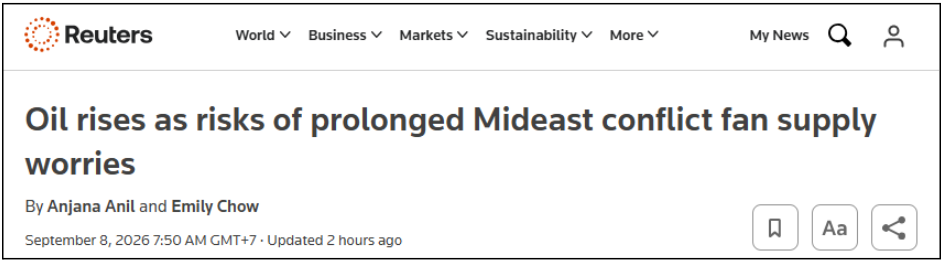
The recent escalation between the United States and Iran has pushed geopolitical risks higher once again, with both sides resuming exchanges of fire. Iran has threatened further retaliation against any new US attacks, while US forces have reportedly struck Iranian oil tankers near Kharg Island, a key Iranian oil export hub. At the same time, shipping traffic through the Strait of Hormuz has slowed as concerns over further escalation grow. These developments have renewed fears of supply disruptions and raised the possibility that the conflict could remain prolonged. As a result, Brent crude rose to around $98.46 per barrel, while WTI climbed to around $93.90 per barrel.
The renewed conflict is therefore putting upward pressure on oil prices, as markets price in a higher risk of prolonged disruptions to Middle Eastern oil supplies. This is particularly important for markets because sustained higher oil prices can feed into broader inflation through increased energy costs.
However, oil prices appear to be increasingly decoupling from gold. Despite the sharp rise in crude oil prices, the move has so far had a limited impact on the market’s expectations for Federal Reserve policy. With the FOMC meeting next week approaching rapidly, the market appears to be increasingly focused on the view that inflation remains elevated, with the possibility of another rate hike already being priced in.
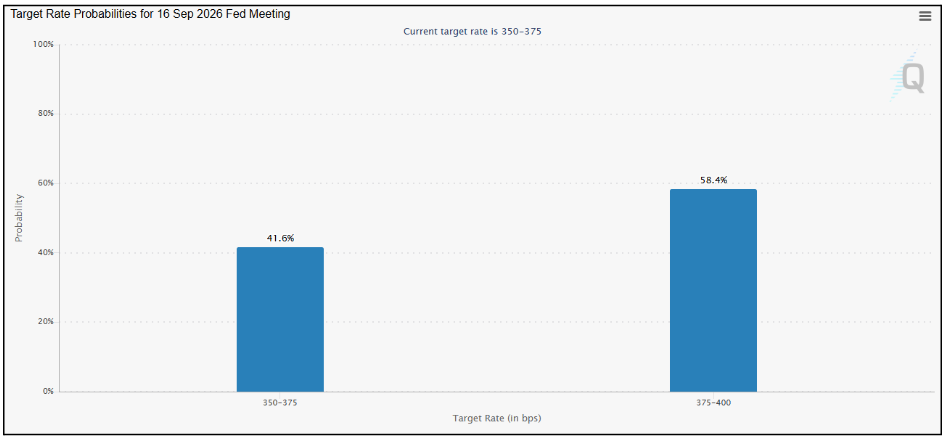
According to the CME FedWatch Tool, markets are currently pricing a 58.4% probability of a rate hike at next week’s FOMC meeting. This suggests that, rather than viewing the latest oil-price surge as a reason to materially shift rate expectations, traders may already be positioning for tighter monetary policy.
For gold, this distinction is important. Higher oil prices would normally create inflationary pressure and could weigh on gold if they strengthen expectations for higher interest rates. However, if rate-hike expectations are already sufficiently priced in, further increases in oil prices may have a more limited impact on gold. With the FOMC meeting approaching, traders should therefore pay close attention to whether incoming inflation data and Fed expectations continue to outweigh geopolitical developments in determining gold’s next move.