
This report highlights key developments for the week ahead, providing investors with relevant context to support informed trading decisions. It covers both fundamental analysis—the primary drivers behind market movements—and technical analysis, including price action and key liquidity zones that traders should monitor.
Disclaimer: This material is provided for educational and informational purposes only and should not be considered as investment advice or a trading signal.
Fundamental Analysis
Three factors to focus on this week from the fundamental side:
Last Week Recap

Last week saw key central banks take different approaches to monetary policy. The Fed raised interest rates, with the decision passing unanimously at 12–0, as inflation remains elevated while the labor market has remained resilient. The Fed’s latest dot plot also points to another rate hike by the end of the year.
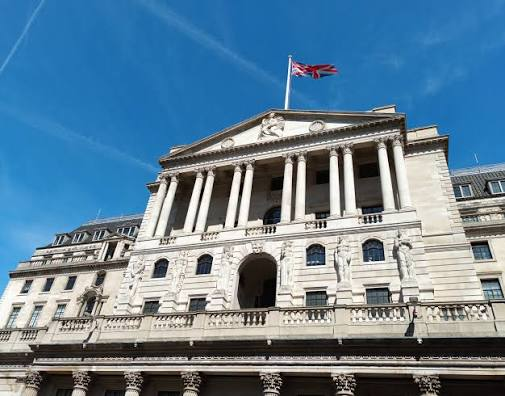
Meanwhile, the BoE held interest rates following a 6–3 vote, with three policymakers voting for a 25-basis-point increase. The decision came despite UK inflation remaining elevated at 3.1%, above the Bank’s 2% target.

The BoJ also raised rates by 25 basis points, but the Japanese Yen weakened against the US Dollar following the decision. The move passed 7–2, and the lack of a clear signal for another near-term hike appeared to disappoint investors who had already positioned for faster policy tightening. As a result, some previously accumulated Yen positions were unwound, illustrating how a rate hike can still be followed by currency weakness when the accompanying guidance is more cautious than expected.
Yen Faces Increased Intervention Risk
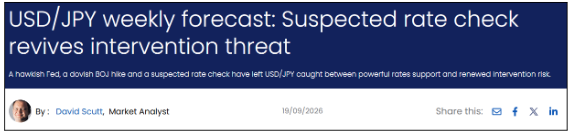
The Japanese Yen initially weakened against the US Dollar last Friday despite the Bank of Japan raising its policy rate by 25 basis points. However, the Yen later recovered after reports emerged that Japanese authorities had conducted a “rate check” in the foreign-exchange market.
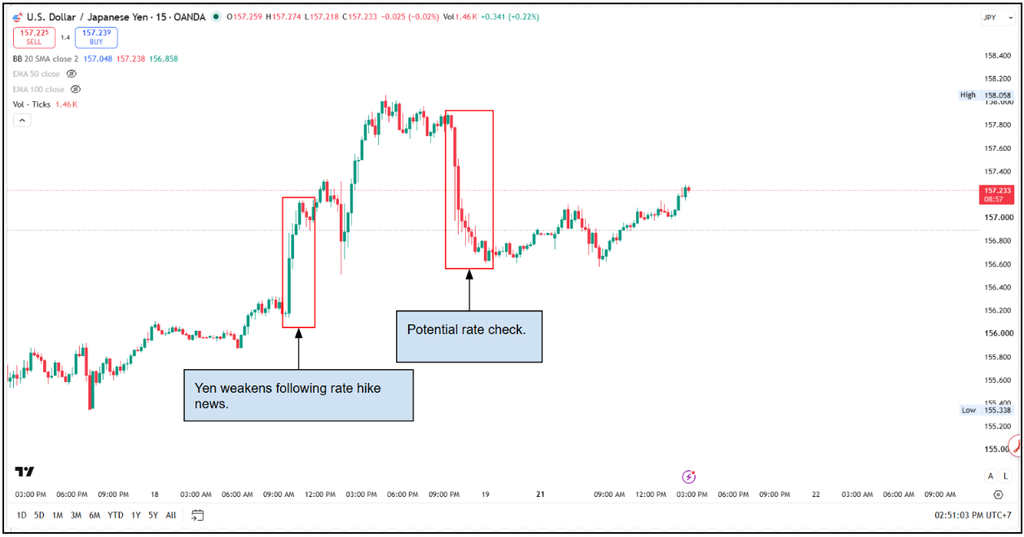
A rate check involves authorities contacting market participants to ask for current exchange-rate quotes and is widely viewed as a potential preliminary step before direct currency intervention.
While a rate check does not mean that intervention has taken place, it can strengthen the Yen by increasing concerns that authorities could soon buy Yen and sell US Dollars to slow excessive Yen weakness. This can encourage traders to reduce USD/JPY long positions, putting downward pressure on USD/JPY and supporting the Yen.
The intervention risk may remain a focus this week, particularly as Japan observes holidays from September 21 to 23, which could result in lighter trading liquidity. Lower liquidity can make currency movements more volatile, meaning relatively smaller orders or official actions could have a larger impact on the exchange rate.
Xi–Trump Summit
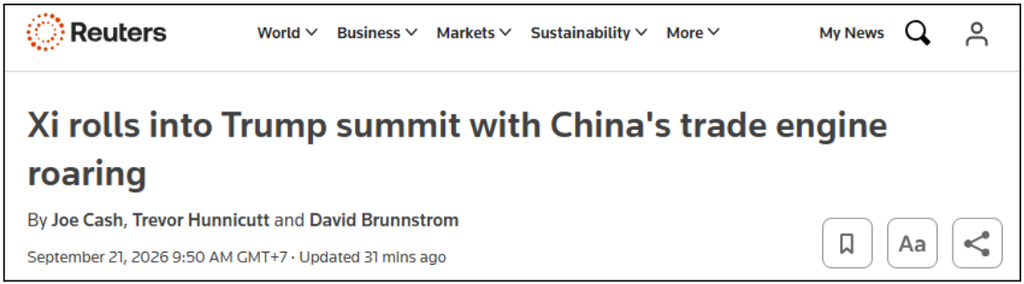
The upcoming Xi–Trump summit on September 24 will be closely watched for developments on the U.S.–China trade truce, Taiwan, and China’s stance on the ongoing U.S.–Iran conflict. On trade, investors will look for signs that the current détente can be extended, particularly regarding tariffs, technology restrictions, and critical-mineral exports. Meanwhile, any changes in rhetoric surrounding Taiwan could influence broader U.S.–China geopolitical tensions and risk sentiment. However, the summit’s potential impact on the Iran war and Strait of Hormuz may be particularly important for markets. A stronger Chinese push for de-escalation or reopening the Strait could ease concerns over oil-supply disruptions, potentially lowering oil prices and inflation expectations, while reducing safe-haven demand for gold. Conversely, limited progress on Iran or renewed tensions over trade or Taiwan could keep geopolitical risk elevated and increase volatility across oil, gold, the USD, and global equities.
Technical Analysis
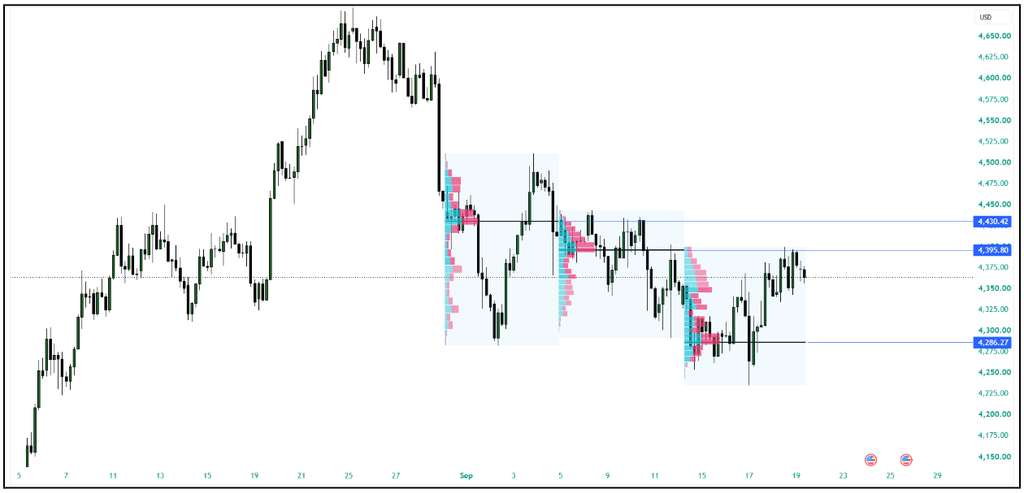
XAU/USD Technical Overview
- Current Bias: Bearish Consolidation (consolidating within the broader weekly downtrend).
- Major Supply Zone: $4430.42 (key overhead structural resistance and prior volume breakdown zone).
- Immediate Resistance / Pivot: $4395.80 (previous week’s Point of Control – POC, acting as the immediate barrier capping upside pullbacks).
- Key Support / Base Pivot: $4286.27 (the latest Point of Control – POC, serving as the critical floor for the current range).
- Downside Target: $4250.00 (recent swing low and primary downside liquidity target).
- Swing Trade Plan: Maintain a short bias while price remains capped below the $4395.80 – $4430.42 resistance block, targeting a retest of the $4286.27 POC down toward $4250.00. A decisive breakout and sustained hold above $4430.42 would invalidate immediate bearish continuation and open the door for an extended relief rally.