

US retail sales The latest US retail sales figures indicate a decline in consumer spending on goods, suggesting a trend of cautious expenditure and potential financial strain as concerns about a trade war loom. In fact, investor sentiment and consumer confidence appear to be leaning negatively recently, which may further dampen discretionary spending on services. Even the stock market is also being hit by a significant sell-off from fear of a recession, which continues to create challenges for the Federal Reserve’s upcoming rate decision this week. Reciprocal Tariff Trump still holds firm on the reciprocal tariff policy that will come into effect on April 2nd, hinting that “there will be the start of a wave of new tariffs.” This will escalate further uncertainty and risk posed to global economics. Even the European Central Bank’s de Guindos also acknowledged that the “Trump administration has increased economic uncertainty due to tariffs and deregulation. Ceasefire Broken Israel launched air strikes on Gaza City, which broke the ceasefire that was made on January 19, pushing the gold price higher in the early morning of Tuesday. Israel Katz cited the possibility of a further strike if Hamas does not release all the hostages that are held in the Palestinian territory. According to a Fox News interview, “The Trump administration and the White House were consulted by the Israelis on their attacks in Gaza tonight.” Looking Forward:

Weekly Data Summary Report As of March 15, 2024
Weekly Data Summary Report As of March 15, 2024 In this report, we will assess major economies, including the United States, the Eurozone, Japan, and Canada, mainly based on their economic indicators and economic events that have occurred within this week. Japan Given how Japan’s economy expanded further along with an acceleration of inflation, there are some drawbacks that Japan may likely face in order to reach its target of 2% GDP by 2027. This comes when the US puts pressure on adding more spending on the defense “at least 3% of GDP” (currently at 1.4% of GDP) at a Senate confirmation hearing. This also means that the growth of Japan’s GDP would also force Japan to spend more on defense. Therefore, attention arises on whether this increase in defense spending would impact Japan’s finances, especially when they have already had a high debt level. Some speculations mentioned that more interest rate hikes will be likely, potentially strengthening the JPY against other currencies. As of now, overall wage income and household spending have dropped, in January, which also reflects a weakness in consumer sentiment ahead of global uncertainty. Canada The Bank of Canada’s move on the rate cut comes as the heat over the tariff war surged higher and recession risk rose. Although this adjustment only lessens the damage to the economy, the risk of slowing down or a possible recession is still very likely with a projection of inflation shock from the trade war. In fact, Trump is still committed to imposing his tariff deal with Canada and Mexico unless “drug flow stops.” The European A trade tension between the US and EU escalated when Trump imposed a 200% tariff on wine, champagne, and other alcoholic beverages from France and elsewhere in the European Union after the EU retaliatory tariff on US imported goods. Trump also added that “EU is treating the US very badly” and “They’re suing Google, they’re suing Facebook, they’re suing all of these companies, and they’re taking billions of dollars out of American companies,” hinting that this tension may take time to ease longer than we expected. The United States Despite US inflation easing for February, the market is still having a softer sentiment on the economic outlook while projecting higher inflation expectations. Even though this higher inflation anticipation could lead to a pause in the FED Fund rate, the CME FEDWatch tool told us otherwise, projecting to have 3 rate cuts this year. This also comes when the stock market has been significantly dropped, while gold has finally reached its peak at $3000 per ounce. All of these indicate that trade tension, fragile economic outlook, and uncertainty in geopolitical tensions are further raising the odds of recession risk.

Stock Market Woes And Gold’s Surge: All Come From The “R” Word.
The stock market has once again experienced another turbulence despite having soft inflation data last night. In fact, the fear index—VIX index—surged higher by roughly 10%, Magnificent-7 took a heavy blow, and S&P500 closed in correction territory, while many are now shifting the focus to safe haven assets such as gold. Here’s something you should know: Arising recession fear is now in charge, not only because of weakness in economic outlook alone, but weak earnings are coming to play, uncertainty in Trump’s unpredictable policies and a completed unresolved geopolitical tension. Trump last night threatened to impose 200% on “all WINES, CHAMPAGNES, & ALCOHOLIC PRODUCTS COMING OUT OF FRANCE AND OTHER E.U. REPRESENTED COUNTRIES” if the tariff is not removed immediately. Not only that, Trump also mentioned that “Canada needs America; America does not need Canada,” raising even more possibility that Trump really meant it when he said he does not care about the stock market. As a matter of fact, Trump’s approach was more on trade war, in which he is willing to take on more short-term pain for the long-term growth. While Ukraine emphasized his concern about a ceasefire with Russia, Trump is committed to preventing this from happening and furthered discussion between Russia and Trump. Furthermore, global hedge funds are selling their assets, and that also includes Warren Buffett, the godfather of the stock market. Even the CME Fedwatch Tool also projects a 3-rate cut this year, which for the last 2 months—many were unsure about further easing. These all show more recession fears from weak investor sentiment, which has led the US stock market to underperform compared to the global market after Trump’s inauguration. Therefore, many investors are now seeking a safe haven asset, although we are still unsure about how long it takes for recovery.

Under one Scope: US Inflation, Canada Rate Cut, and EU-US Trade
US Inflation Headline: Although US inflation was lower than anticipated—primarily due to a decline in travel demand and a weakening housing market—egg prices have still risen significantly. This indicates that consumer spending is still disrupted by higher costs of living. Especially when the tariff effect has not fully been felt yet, many still believe that the recent figure might be a short-dip instead of a downtrend in inflation. As a result, the odds of more than 90% standing on holding the interest rate next week until mid-year. The Bank of Canada: The Bank of Canada decided to reduce the interest rate to 2.75% this meeting as expected, citing that “we’re now facing a new crisis,” amid uncertainties related to the trade war with the US. This tariff tension is likely to trigger an inflation shock while posing serious risks to Canada’s consumer spending, employment, and economic growth. Therefore, this is a call for last night’s cut. Furthermore, the Canadian finance minister has also expressed a commitment to engaging in further discussions with the US, seeking relief from US tariffs. If the US can be persuaded, the potential for tariff-induced inflation may decrease, although the impact is expected to be limited. EU-US trade: Following the implementation of a 25% tariff on steel and aluminum, trade tensions between the EU and the US have intensified. The EU plans to impose tariffs on US goods valued at €26 billion (approximately $28.31 billion) starting next month. In response, President Trump announced intentions to implement retaliatory tariffs, although specific details on the measures have yet to be clarified.

US Inflation Headline: What to Expect
Tonight’s consumer price index will offer insights regarding inflation data under Trump’s trade war in February. Many have already anticipated a drop to 2.9% annually and 0.3% monthly, as shown below. Reasons why inflation can be higher: 1. Market sentiment and inflation expectations are actually rising so much from trade war tension, showing that they have already lost faith in the Fed’s control strategy. 2. As mentioned before, purchasing managers’ index reports and export & import pricing are showing a flaring inflation. In fact, CPI has been rising since September—Trump’s elected campaign. Reasons why inflation can be lower: 1. Lack of demand because more consumers choose to save first and spend later in the face of uncertainty and recent layoffs. 2. Competitive among the industry as businesses choose to reduce the cost of employment instead of passing on the burden cost to customers. Which is why we also see a higher unemployment rate for February (this also comes from Trump’s layoff policies as well). Extra information: Despite Trump’s comment on recent disinflation progress last night, this does not ease some tension yet. The market still reacts to the inflation problem. Yet, the CME Fedwatch tool still offers 3 rate cut probabilities within this year.

After Much Back-And-Forth, This Is What Trump Has Come To The Conclusion
While President Donald Trump attempts to assert control over the steel market through tariff threats aimed at neighboring countries, the stock market is heavily hit by his recent proposal. Last night, Trump announced plans to impose an additional 25% tariff on steel, which would raise the total tariff on Canadian steel to 50%. This follows after Canada’s implementation of a 25% electric tariff on the US. After much back-and-forth, now Trump has come to the conclusion: Other than this,
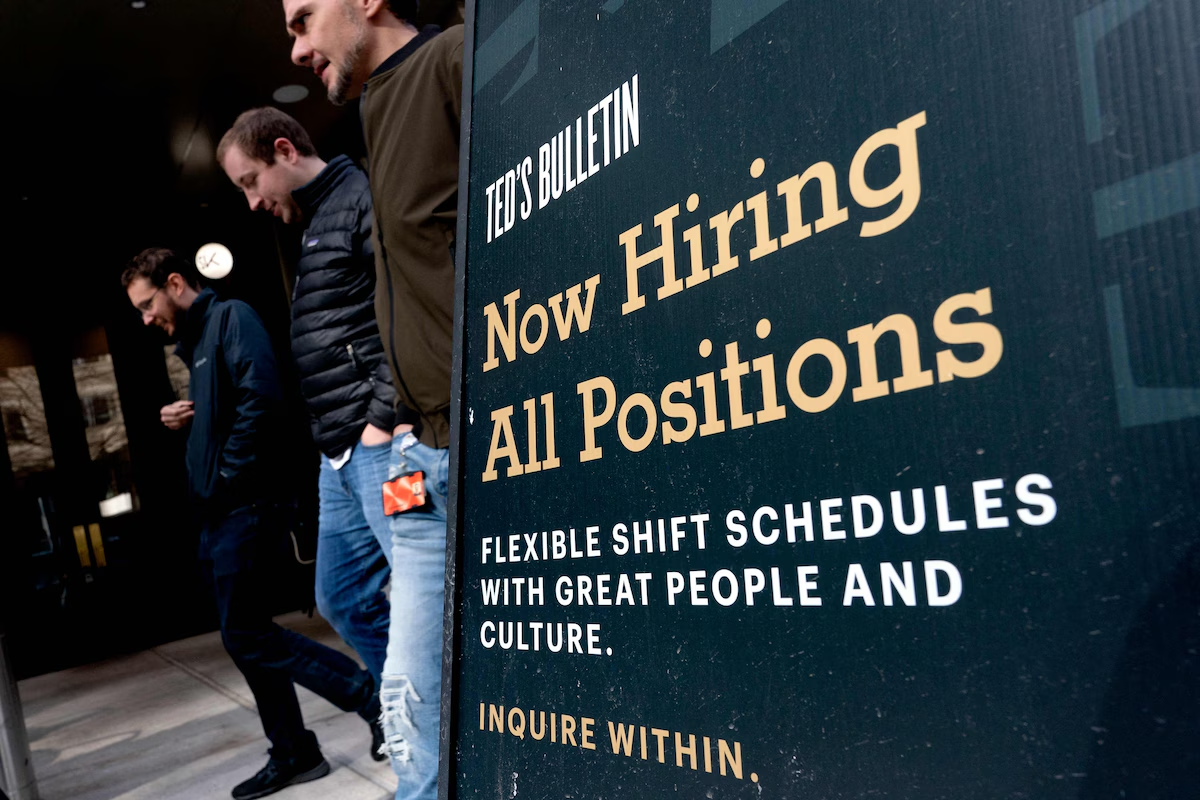
US JOLTs Job Openings: What’s More After the Friday’s Employment Report?
Despite the majority of job data pointing toward a weakness condition last week, tonight’s labor data might not result the same way or maybe it does? The projection reading has a higher than prior figure. One way to look into tonight’s report is to look at each category listed in this report, including the number of hirings, separations, and job openings, which offers a broader understanding of the labor market conditions. Extra Information: Even Trump also brought out the possibility of a recession on Sunday. So there is a chance that this so-called “period of transition” may need to face a labor shortage or poor job market conditions in the near future.

Trump’s Remarks Raise Recession Concerns: Could This Open Opportunities for the US Economy?
After President Trump’s comment on a possible “period of transition,” which suggests a possibility of recession in the US economy due to recent trade tension and weakness in economic growth, many stocks tumbled and sold off on Monday, the first opening market of the week. Despite this, the question is: can the US economy benefit from this so-called possible recession? Probably. And here is a reason why. First, take note that this is opinion-based only and do not take this as an investment decision. So if recession and interest rate cuts really come, then there are two possible good news: disinflation due to lack of demand and a reduction in debt servicing costs. However, the real challenge of this method is timing and durability, as this will hurt consumer spending really badly and make the economic outlook look really doomed. If they cannot revive this in time, then this will push forward to a deeper recession.
Weekly Data Summary Report As of March 07, 2024
Weekly Data Summary Report As of March 07, 2024 In this report, we will assess major economies, including the United States, the Eurozone, Japan, Australia, the United Kingdom, and Canada, mainly based on their economic indicators and economic events that have occurred within this week. Australia Despite a hawkish rate cut from the Reserve Bank of Australia(RBA), a report from the purchasing managers index in the service sector also stated that there is ongoing positive sentiment coming through economic activities along with fallen inflation data. This fuels more anticipating the interest rate cut this year. Even with the gross domestic products for the last quarter of 2024, they also rose above the RBA’s forecast to 1.3% and they further expect growth to be 2% over 2025. Japan Although the Purchasing Managers’ Index (PMI) report from the services in Japan also brought out the optimistic outlook from the business, the unemployment rate for January rose higher than the prior figure, which indicates a softening in the labor market conditions. This also raised some concerns over the economic outlook, especially when the Bank of Japan members affirm that tariffs will obviously affect the Japanese economy. With that, the BOJ has not fully pre-set on the rate decision yet, which mentioned that they will use wage growth as the key gauge of inflation. Canada Uncertainty from trade policy has already deteriorated Canada’s economy, with many businesses adopting aggressive profit margin protection through cutting down the employment level while increasingly raising the selling prices amid a competitive environment. And that is why many business activities have setbacks, bringing down the employment level and economic growth to some degree. In fact, China also imposed 25% on Canadian imports, which goes into effect on March 20, 2025. Trump is also considering imposing more tariffs on Canada, particularly on lumber, on either Monday or Tuesday after his statement on USMCA imported goods. The Europe Given how the European Central Bank cut the interest rate by 25 bps to 2.65, many are still hopeful that Europe can be saved from the past terrible downturn. Political instability in France, stagnate growth in Germany, and global news are all raising more discouragement on consumer spending, which ultimately leads to a decline in overall growth. The United States The majority of data is showing us two things: one is that accelerated inflation is definitely eating into consumer spending, and two, weakness in labor market conditions is likely to be confirmed despite a rise in nonfarm payroll. So what now? What we are seeing right now gives a complex picture. But one thing is for sure: inflation is coming back and if the labor market conditions are unable to keep up with high inflation, then we are likely to see more of a “stagflation scenario” posing a threat to the US economy. Now all eyes should fall on the new initiative on Trump’s tariff, gold premium cards, and more policy changes. Forward looking:

Employment Report Alerts Tonight at 8:30PM (GMT+7)
US Labor data will be released tonight at 8:30 PM (GMT+7) with a mixed projection between each data. Here are things you should be aware of: 1. Worse Sentiment: recent uncertainty in policy changes, either trade conflict, federal budget cutting, or new government policies are taking a toll on demand, consumption, and business activities, while inflation is flaring around; all of these are showing signs of being reluctant in hiring activities. 2. not only the sentiment of uncertainty ahead, the recent downsizing workforce is likely to diminish the strength of labor market conditions. 3. Purchasing managers’ index reports from ISM, S&P, and ADP employment changes are making sure that we know about softening in the employment level. Despite this, that does not always set a 100% path for upward GOLD prices. There are other factors to consider, such as the Federal Reserve member speech (Powell, Bowman, and William), Trump’s summit, and other geopolitical events.